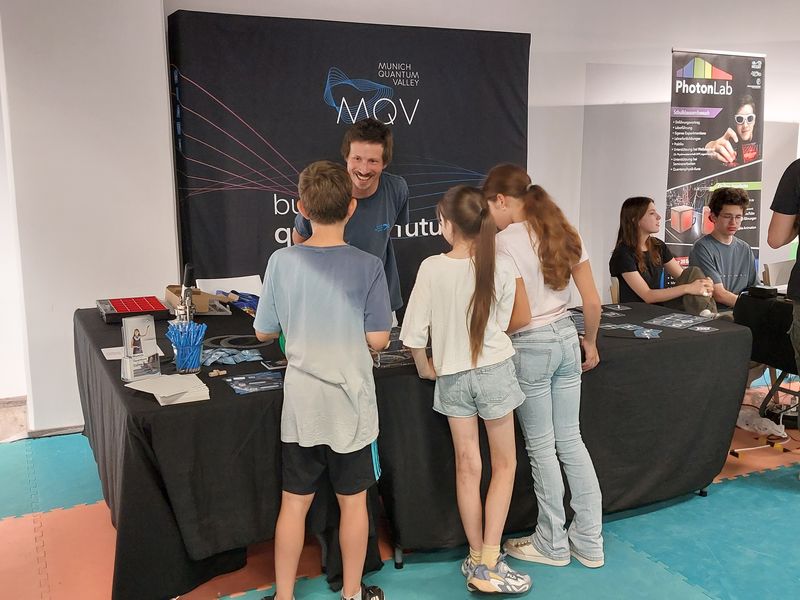
On Friday morning, when school classes and preschool groups are traditionally invited to visit FORSCHA, the button machine at the Munich Quantum Valley (MQV) booth was in high demand. From 9 a.m. until noon, the line of eager children waiting to press their own quantum-themed buttons to take home as souvenirs never got any shorter. While the youngest visitors playfully explored the properties of light with plate-sized polarization filters or learned what an atom is, older students bombarded the booth staff with questions about quantum physics and technologies. Exhibits from MQV member institutes, such as the 17-qubit chip from the Walther Meißner Institute, sparked interest and offered concrete insights into the development of quantum computer hardware. The beer coasters featuring various logic gate designs were also popular. They could be assembled into quantum circuits, encouraging visitors to build their own small circuits. Starting Friday afternoon, the crowd included an increasing number of prospective students and adults.
Right next to the MQV booth, MQV member institutes and partners provided further exciting insights into the field of quantum sciences and technologies. The student laboratory PhotonLab offered hands-on experiments involving lasers, light, and quantum phenomena, and on Sunday presented the fourth episode of its radio play “Alice im Quantenland” as part of a reading. At the Leibniz Supercomputing Center’s booth, visitors could use VR goggles to explore the interior of a cryostat for superconducting quantum computing, “zoom in” on the cryostat, and discover various details such as the superconducting quantum processor or the microwave guides that connect the processor to the outside world. Additional activities related to quantum science were available at the booth of the Cluster of Excellence "Munich Center for Quantum Science and Technology", including playful games such as “quantum versions” of Tic-Tac-Toe and Memory.
On Sunday afternoon, there was another highlight for all FORSCHA visitors interested in quantum physics: In his presentation “Rechnen mit Atomen: Wie wir mit den Bausteinen der Natur komplexe Probleme lösen können”, MQV researcher Prof. Johannes Zeiher explained how scientists use laser light to cool individual atoms to near absolute zero, make them visible one by one, and control them – thereby building quantum computers atom by atom.