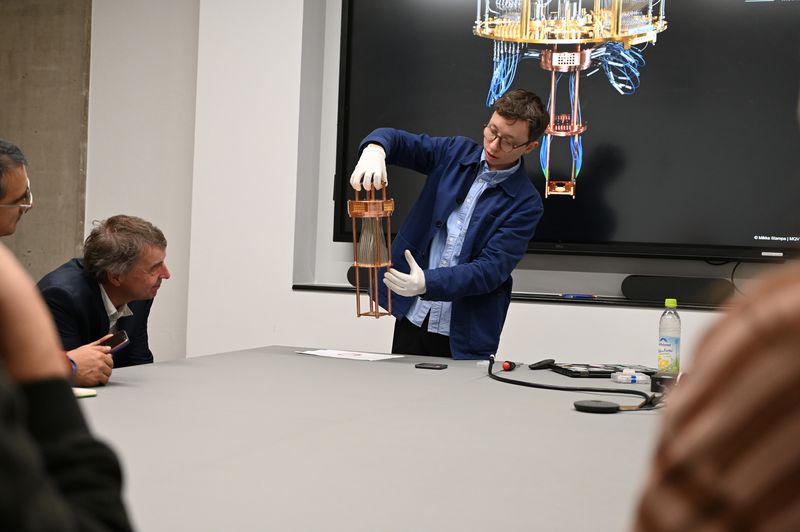
To kick off the evening, Prof. Hans Huebl, one of the directors of the WMI, introduced the history of the institute and the beginnings of low-temperature research. In addition to the institute's founder and namesake, Walther Meißner, a pioneer of low-temperature physics and superconductivity, Huebl also talked about Carl von Linde, who laid the foundations of modern refrigeration and cryogenic technology. The refrigeration machines Linde developed originally freed breweries from their dependence on natural ice. Today, the WMI is home to far more advanced refrigerators with much more complex applications: cryostats capable of cooling superconducting quantum chips to near absolute zero.
Following the introduction, visitors moved through stations across the institute to get a closer look at the work and research being done at the WMI. Even though all the cryostats in the cryo lab were "cold" at the time, meaning the processors inside were running and the shimmering gold interiors were hidden behind shielding for thermal insulation, the loudly huffing compressors and blinking control electronics still made for a vivid impression.
