Exploring the world of nanomaterials: MQV Girls’Day at the Walter Schottky Institute


On 23 April 2026, 14 girls aged 14 to 16 took part in the Munich Quantum Valley Girls’Day program, which was held this year in collaboration with and at the Center for Nanotechnology and Nanomaterials at the Walter Schottky Institute (WSI). Through experiments and a lab tour, the participants gained a comprehensive insight into research on two-dimensional materials and were able to perform various tasks that are part of the researchers’ daily work at WSI.

To start the day, the girls begin by making their own lab notebooks. Using A4 sheets, a stapler, a red cover, and a label for their names, they quickly put together small notebooks much like the ones the scientists at WSI use daily. Once they’re ready, the girls get right into the main program.

Nina Pettinger, a doctoral student at the WSI, begins with a brief introduction. She explains what two-dimensional materials are – ultra-thin layers of material, some of which are only one atom thick. Then it’s time for the girls to make their own material samples. To do this, they first need a suitable substrate for their material. Nina Pettinger and Johannes Schmuck, also a WSI doctoral student, demonstrate the process known as wafer cleaving to the girls, which involves breaking the silicon wafer precisely into small pieces. Using a sharp, scalpel-like knife, Nina Pettinger marks the break point and then breaks the wafer along it. After the professionals' introduction, the girls get to try it themselves, and before long, there are plenty of small rectangles of silicon substrate ready to go.

Producing ultra-thin layers of material, just like the researchers do in the lab

Applying the material sample to the silicon substrate requires dexterity.

The next step is what’s known as exfoliation. One by one, the girls use standard adhesive tape to peel off a thin layer of material from a graphite crystal about one centimeter in size. Then, Johannes Schmuck demonstrates how to obtain increasingly thinner layers using another piece of adhesive tape by repeatedly sticking the two strips together so that the material is trapped in between, and then peeling them apart. Since it takes quite a bit of practice to actually exfoliate single layers of graphite – that is, graphene – the goal on Girls’Day is to obtain the thinnest possible graphite flakes. The two scientists advise the students to hold the adhesive tape strips up to the light to check whether light gray areas are visible – that is, areas where the material is already very thin and thus more translucent. The girls eagerly put Johannes Schmuck’s suggestion into practice – to feel free to exfoliate several strips of adhesive film, since even in real-world work, a satisfactory result is often only achieved on the sixteenth attempt, as he says. By the end of the day, three rolls of adhesive film have been used up.

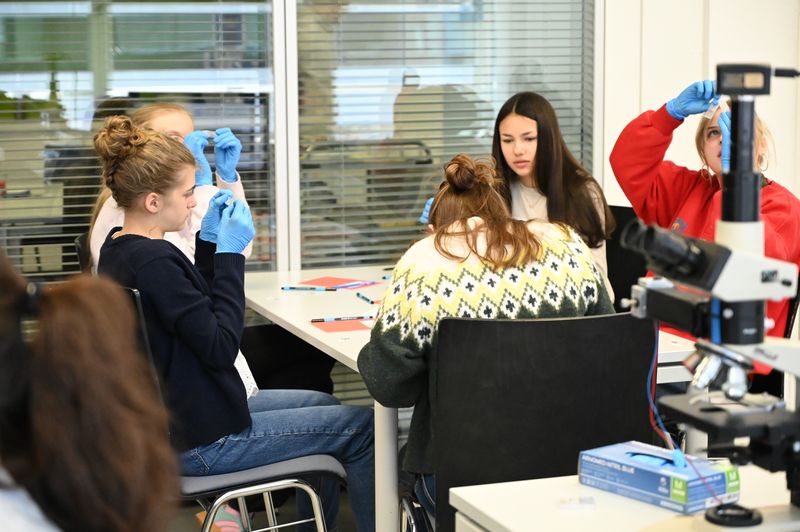
The material samples that the girls consider the most promising are then applied to the prepared silicon substrates. Since heat helps the material adhere better to the substrate and peel away from the adhesive film, this step is performed on a hot plate. Working with tweezers and other tools certainly requires some “fiddly work”, but the girls all demonstrate a great deal of dexterity. Finally, their samples are ready. They will check later under a microscope to see if they contain “good flakes” – that is, graphite flakes that are thin enough. First, though, it’s time for a tour of the institute.

Looking over researchers' shoulders during a lab tour

The girls carefully plot the data points of their current–voltage measurement in their lab notebooks.

Divided into two groups, the students visit various labs, including the chemistry lab as well as various other labs where WSI researchers examine their material samples under extreme conditions, such as very strong magnetic fields or ultra-low temperatures, or using lasers. A highlight of the tour is a glimpse into the cleanroom, where the air is virtually free of particles and samples are prepared. Several scientists are hard at work inside the cleanroom as the girls pass by, so the students can watch them – fully suited up in cleanroom suits complete with caps, face masks, special shoes, and gloves – handle chemicals or inspect samples under a microscope through the large windows. 

After a lunch break in the sunlit seating area in front of the institute, the girls continue with their own experiments. They place the samples they prepared earlier under the microscope and meticulously scan them in search of a beautiful graphite flake. Since the microscope is connected to a large screen, the girls can work together to search for it. Once a flake is found, it is photographed and printed out for each participant. Then, the girls paste the printout, along with their adhesive tape strips, into their lab notebooks for documentation. They brainstorm together, eagerly discussing how to best record what they’ve done in writing. Every now and then, they check in with Nina Pettinger and Johannes Schmuck to make sure they’re using the correct terminology: “E-x-f-o-l-i-a-t-e?”

Last but not least, the girls get to measure the current-voltage characteristic curve of a sample. They set different voltages on the meter, read the current, and carefully plot the data points on the coordinate system they’ve already drawn on graph paper and pasted into their lab notebooks. The data points form a straight line. “That’s ohmic resistance!” one of the girls exclaims.

To conclude the program, Nina Pettinger and Johannes Schmuck share some details about their day-to-day work. It’s not just about lab work. Conferences, where you present your research and discuss interesting questions with other researchers, are also part of the job of a scientist. Barcelona, Venice, Paris – getting to see a beautiful city or two along the way is a very nice side effect of this scientific exchange. One of the girls wants to know what studying physics is like. Another student says she’s particularly interested in electrical engineering. With new insights and a well-filled lab notebook, the students make their way home.