The symposium is a joint initiative of the Munich Center for Quantum Science and Technology (MCQST) and the Munich Quantum Valley (MQV). Its aim is to support promising early-career scientists, encourage scientific exchange, and foster a diverse and inclusive quantum research community.
Quantum Talents Symposium 2026: Celebrating the next generation of quantum researchers
On 26 and 27 October 2026, the Munich quantum science community welcomed eight outstanding Ph.D. students and early-career postdoctoral researchers to the Quantum Talents Symposium. The event provided an opportunity for emerging researchers from around the world to share their work, engage with the scientific community in Munich and connect with potential future collaborators.
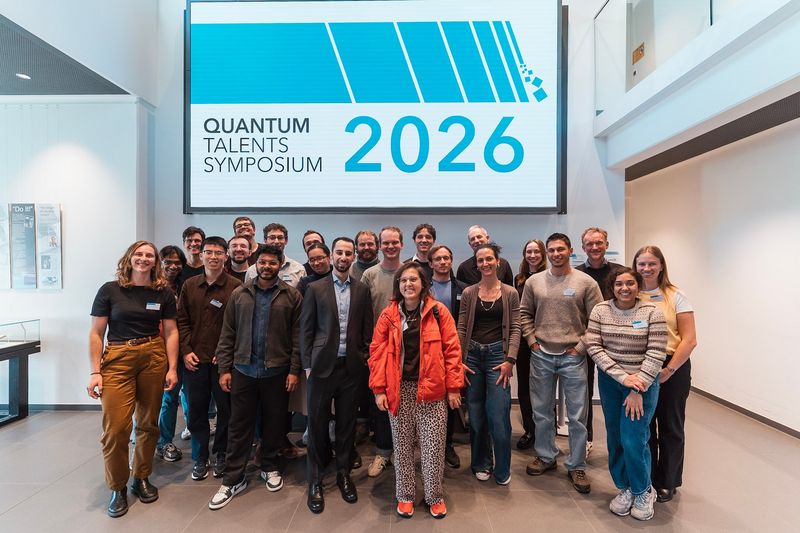
Bringing together the next generation of quantum scientists

The 2026 finalists represented research institutions across Europe and North America:
- Roland Farrell – California Institute of Technology (Caltech)
- Lukas Homeier – JILA, University of Colorado Boulder
- Yusuf Karli – University of Cambridge
- Aron Kerschbaumer – Institute of Science and Technology Austria
- Jonah Peter – Harvard University
- Andrei Rasputnyi – Max Planck Institute for the Science of Light (MPL), Erlangen
- Camryn Undershute – Michigan State University
- Pranshoo Upadhyay – Joint Quantum Institute, University of Maryland
The Quantum Talents Symposium once again highlighted the benefit and importance of supporting the next generation of quantum scientists, by providing a platform for talented early-career researchers to present their work, exchange perspectives and establish connections within the international quantum science community.
Beyond the two days of the symposium programme, the finalists were funded to stay for a full week of exchange visiting with Munich research groups, with the opportunity to connect with researchers across Munich's quantum science institutions and experience the local research environment first-hand.
As finalist Lukas Homeier shared:
"I believe the Quantum Talents Symposium is unique in bringing together junior international scientists from a wide range of backgrounds in quantum science"
Three Minutes of Science

The symposium program opened on 26 October with the Three Minutes of Science contest, where researchers from the Munich quantum science community presented their work in concise, accessible three-minute talks. This provided an engaging opening to the overall symposium programme, bringing together researchers from across Munich's quantum science community in scientific exchange that continued throughout the following two days.
Five researchers took part in the final pitch competition, having attended a dedicated science communication training:
- Saya Schöbe (Walther-Meißner-Institute): Who flipped my Qubit? A quick guide to being a quantum detective.
- Anouar Kouraich (TUM): Why does nature love Gibbs states?
- Karolina Weber (TUM): Hybrid quantum networks via Erbium
- Ahmed Barakat (TUM): Mechanics Joins Quantum Technology
- Adelina Bärligea (University of Augsburg): Quantum Computations That Are Secretly Small
The presentations were evaluated by a jury consisting of Rudolf Groß (Walther-Meißner-Institute), Judith Gabel (Deutsches Museum) and Alexander Hahn (TUM).
Congratulations to Karolina Weber, who was selected as the winner of the Three Minutes of Science contest, and who received a prize of a 1000 EUR travel grant, supporting the winners' participation in a conference, workshop or scientific meeting of their choice.
Jury member Rudolf Groß highlighted the importance of communicating quantum science in an accessible way:
"Is quantum science and technology difficult and hard to understand? No, it is not, if presented in the right way. This was demonstrated by five enthusiastic quantum science communicators within the MCQST Science Pitch Contest in an excellent way. Congratulations to all participants – you did a great job!"
Quantum Talents prizes

The main symposium program took place on 27 October, when all eight finalists presented their research to an audience of researchers from Munich and beyond. The 2026 finalists represented a broad range of research areas, and their presentations covered topics ranging from quantum many-body physics and strongly correlated quantum matter to quantum optics and quantum information. The talks were followed by a poster session, providing additional opportunities for in-depth scientific discussions and exchange with members of the local quantum community.
A highlight of the symposium was the award ceremony during the closing dinner in Garching. Following the presentations, the jury recognised three researchers for the outstanding quality of their presentations and scientific contributions.
The Quantum Talents prizes, sponsored by IQM, were given out in two equally weighted awards, and the Entanglement Prize, sponsored by the QuantumLeaks Foundation, was decided by the jury as follows:
- Quantum Talents Prize (€2.000): Aron Kerschbaumer, for his work on Weak Ergodicity Breaking.
- Quantum Talents Prize (€2.000): Camryn Undershute, for her work on Engineered Decoherence in Hybrid Mechanical-Superconducting Systems.
- Entanglement prize (€5.000): Roland Farrell, for his work on Efficient realization of long-range entanglement
We congratulate all eight finalists, the prize winners and the Three Minutes of Science participants on their achievements, and thank the jury, sponsors and participating institutions for their contributions to the 2026 Quantum Talents Symposium.