Divided into two groups, the students visit various labs, including the chemistry lab as well as various other labs where WSI researchers examine their material samples under extreme conditions, such as very strong magnetic fields or ultra-low temperatures, or using lasers. A highlight of the tour is a glimpse into the cleanroom, where the air is virtually free of particles and samples are prepared. Several scientists are hard at work inside the cleanroom as the girls pass by, so the students can watch them – fully suited up in cleanroom suits complete with caps, face masks, special shoes, and gloves – handle chemicals or inspect samples under a microscope through the large windows.
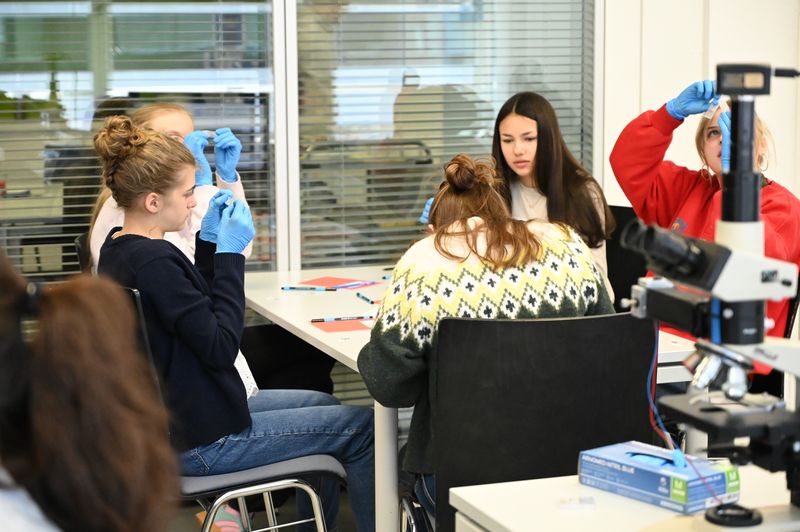
After a lunch break in the sunlit seating area in front of the institute, the girls continue with their own experiments. They place the samples they prepared earlier under the microscope and meticulously scan them in search of a beautiful graphite flake. Since the microscope is connected to a large screen, the girls can work together to search for it. Once a flake is found, it is photographed and printed out for each participant. Then, the girls paste the printout, along with their adhesive tape strips, into their lab notebooks for documentation. They brainstorm together, eagerly discussing how to best record what they’ve done in writing. Every now and then, they check in with Nina Pettinger and Johannes Schmuck to make sure they’re using the correct terminology: “E-x-f-o-l-i-a-t-e?”
Last but not least, the girls get to measure the current-voltage characteristic curve of a sample. They set different voltages on the meter, read the current, and carefully plot the data points on the coordinate system they’ve already drawn on graph paper and pasted into their lab notebooks. The data points form a straight line. “That’s ohmic resistance!” one of the girls exclaims.
To conclude the program, Nina Pettinger and Johannes Schmuck share some details about their day-to-day work. It’s not just about lab work. Conferences, where you present your research and discuss interesting questions with other researchers, are also part of the job of a scientist. Barcelona, Venice, Paris – getting to see a beautiful city or two along the way is a very nice side effect of this scientific exchange. One of the girls wants to know what studying physics is like. Another student says she’s particularly interested in electrical engineering. With new insights and a well-filled lab notebook, the students make their way home.