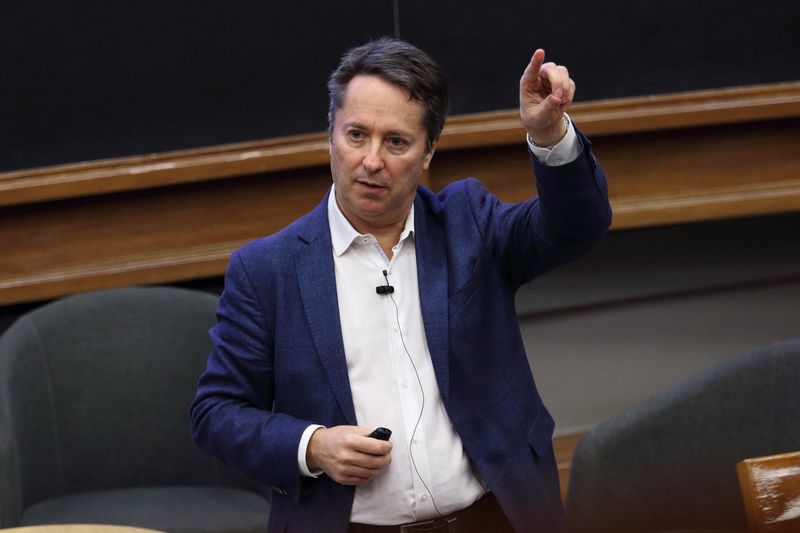
Ignacio Cirac receives the prize for his seminal contributions to quantum optics, quantum information science, quantum many-body theory, condensed matter theory, and mathematical physics. The prize committee acknowledges Cirac’s central role in establishing the theoretical foundations of quantum information processing, including the theory of entanglement, quantum simulation, and tensor-network methods, profoundly influencing both experimental realizations and theoretical developments across modern physics.
Cirac’s ideas have turned fundamental concepts in quantum mechanics into concrete proposals that have shaped quantum science and paved the way to its technological applications. The intuition that atoms and molecules could be used as qubits for quantum computing led Cirac and Peter Zoller in 1995 to develop a protocol to build quantum computers using trapped cold ions—an idea that is still pursued in experiments. Cirac also developed a framework that has changed how physicists think about entanglement, by showing that this property can be properly quantified, controlled and used in applications. He understood that systems of many body quantum particles can be used as quantum simulators to tackle problems in chemistry and materials science, currently one of the most promising near-term applications of quantum technology.
The ICTP-IBM Richard Feynman Prize in Quantum Computing was established jointly by the International Centre for Theoretical Physics (ICTP) and IBM in 2025 and was awarded for the first time this year. The prize, named in honor of quantum mechanics pioneer Richard Feynman, recognizes established researchers who have made significant contributions to the field of quantum computing. It is intended to be a top award in its field.
Text adapted from the ICTP announcement.