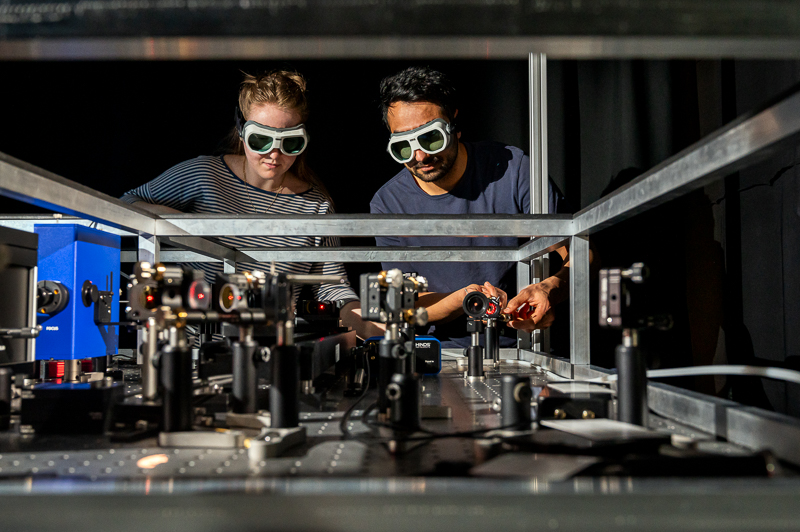
At this year's Girls'Day, organized by Munich Quantum Valley together with the Center for Nanotechnology and Nanomaterials of the Walter Schottky Institute, female students can expect an exciting insight into the world of quantum materials.
How can atomically thin materials be produced using ordinary adhesive tape? What role does quantum physics play in understanding the properties of these materials? What does a typical day for the researchers at the Center for Nanotechnology and Nanomaterials look like? Girls can find out this and more during the Girls'Day.
Further information and registration on the Girls'Day website [in German].
Further offers in the MQV network
As in previous years, numerous members and partners in the MQV network are also offering exciting Girls'Day programs this year.
- At the Max Planck Institute of Quantum Optics, girls learn all about lasers, light, and atoms. More information here [in German].
- At the Munich Center for Quantum Science and Technology, girls can embark on an exciting journey into the world of quantum physics. More information here [in German].
- At the Fraunhofer Institute for Electronic Microsystems and Solid State Technologies, girls can explore the world of microelectronics. More information here [in German].
- At the Max Planck Semiconductor Laboratory, girls learn about sensors that detect invisible radiation. More information here [in German].
- At the Walther Meißner Institute, girls can explore the world of low-temperature physics and learn how to operate quantum computers, which require ultra-low temperatures. More information here [in German].