On this sunny June afternoon, around 50 visitors made their way to Erlangen for the event "Quantum Computing: From Hardware to Software to Industrial Applications", hosted by MQV in collaboration with Fraunhofer IIS. To begin, Dr. Daniel Scherer first broke down the term "quantum computer" into its two parts – "quantum" and "computer" – before reassembling them to explain quantum computing technology and its capabilities. Five additional short presentations then delved deeper into specific technical aspects of the technology. Dr. Kilian Dremel presented an exciting use case for quantum computers in industrial X-ray systems: the use of quantum computing to optimize computed tomography (CT) images. Dr. Friedrich Wagner addressed the algorithmic level and explained how quantum computers and classical computers are intended to work together using hybrid algorithms to solve a problem. Dr. Daniel Scherer spoke at the programming system level about quantum compilers, computer programs that translate a programming language for quantum computers into a machine language that can be executed by a quantum computer. The goal of this is to enable computational operations to be executed as efficiently as possible. At the control level, Thomas Thönes began by presenting his group’s work on integrated high-frequency circuits. The Fraunhofer IIS’s many years of expertise in building particularly energy-efficient radio receivers and transmitters can be readily applied to quantum computing with superconducting qubits, which must be precisely controlled and read out in the gigahertz range. Moving on to the hardware level, Robert Koch explained the principle of a quantum computer using trapped atoms, with the versatile use of different lasers generating great interest among the audience.
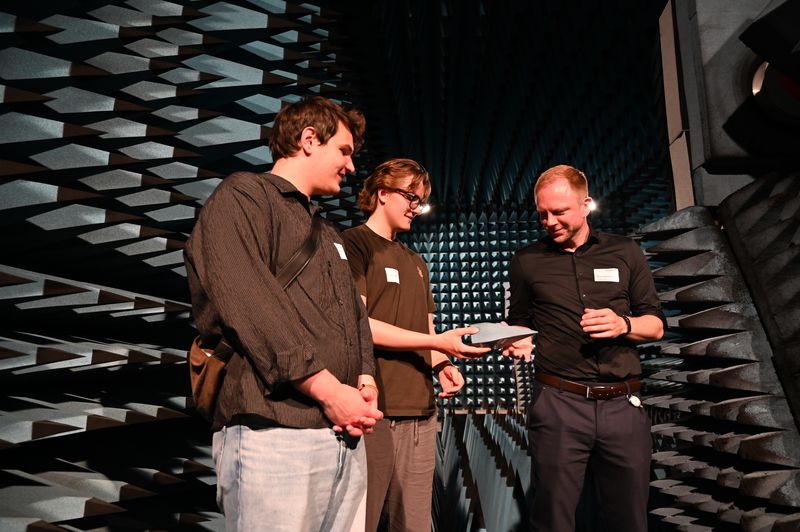
During the subsequent tour of the institute, which included several stops, quantum research became tangible for the visitors. The antenna measurement hall made a particularly strong impression; it is completely lined with dark, pyramid-shaped synthetic absorbers that fully shield the room from electromagnetic waves coming from outside. In addition to antennas of all types and sizes, the hall is also used to test a shielding device developed at Fraunhofer IIS as part of its quantum research. As Tobias Wache explained, this device protects sensitive quantum systems from electromagnetic fields. The sound-absorbing properties of the wall paneling created a unique atmosphere during his presentation. Another stop was the cryogenic laboratory, where visitors could view a small cryostat as well as a quantum control module, a chip measuring just a few centimeters. The control electronics for various quantum hardware platforms were also part of the tour. The basics of quantum computing learned at the very beginning – qubits that can be in superposition and become entangled with one another – were finally put to the test in "TiqTaqToe", the quantum version of the classic game. The simple rules of the game are expanded to include quantum mechanical states and an element of chance. After some initial uncertainty about the additional rules, two participants were eventually driven by the ambition to play an aggressive game. With a "well played," the winner and loser shook hands – fair play even in the world of quantum computing.
You can find out more about quantum technologies at the Fraunhofer IIS at the Fraunhofer IIS website.