The first presentation was given by Professor Florian Marquardt, director of MPL and head of its Theory Division. He explained the quantum mechanical principles that enable quantum computers to execute certain algorithms with remarkable efficiency and why these fragile quantum states also render them susceptible to errors. His division is addressing this issue with an unusual partner: neural networks developed and trained to more precisely control quantum computers.
The timing of the second topic of the evening could hardly have been better. Just days before the event, a test network for quantum communication linking Bavaria, Thuringia, and Berlin was officially activated. Professor Christoph Marquardt, whose team at MPL and FAU Erlangen-Nürnberg investigates the underlying technologies, introduced the audience to quantum key distribution, a method that uses the laws of quantum physics to generate secret keys that ensure data security in the long term, even with the prospect of powerful quantum computers.
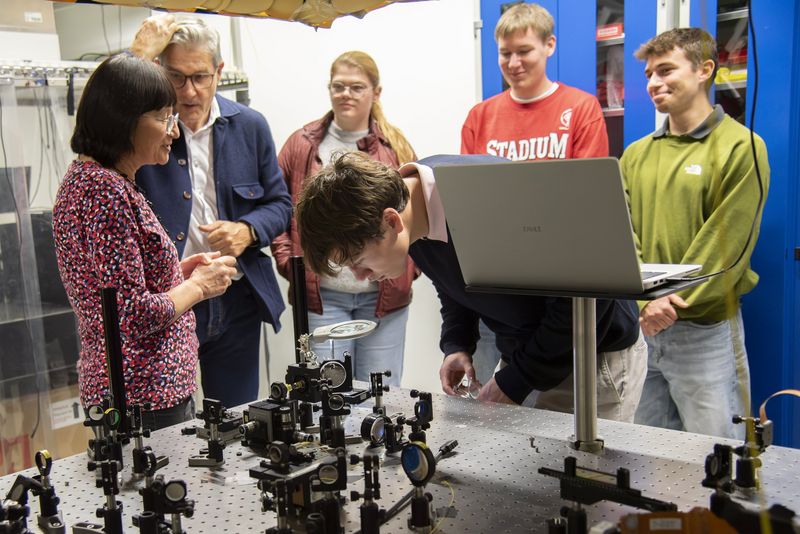
After the talks, visitors saw quantum research firsthand. In Dr. Pascal Del’Haye’s group, visitors observed how photonic chips use quantum light to transmit and store data. One particularly relevant aspect of quantum communication is the ability to generate two-photon states directly on a chip. Prof. Maria Chekhova and her “Quantum Radiation” research group demonstrated how entangled photons can be produced with metasurfaces, paving the way for highly precise quantum states. In Prof. Birgit Stiller’s lab, the focus was on the interplay of light and sound. Her team takes advantage of the different speeds at which light and sound waves travel to develop new quantum technologies and neuromorphic computing approaches.
We thank all the speakers and lab teams at MPL for an evening that demonstrated the breadth of quantum research in Erlangen – from theory and AI to photonic chips and secure communication.