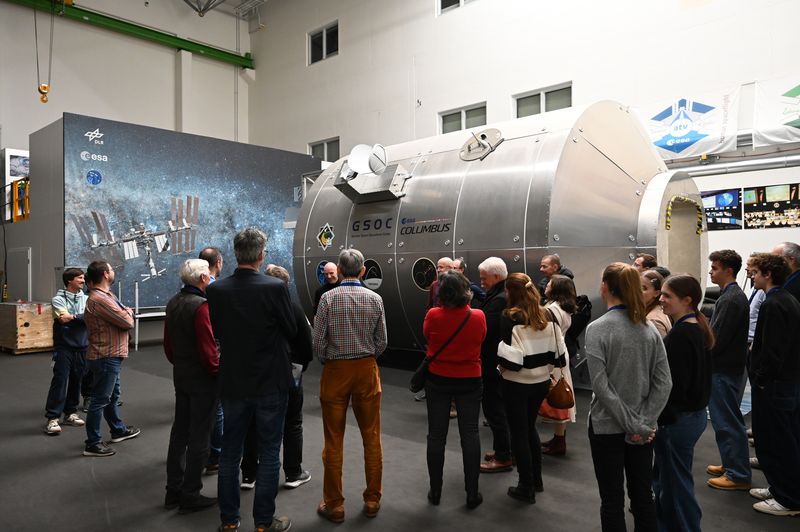
Traffic jams on the highway and gathering fog did not deter the interested visitors on Tuesday afternoon from making the journey to the grounds of the German Aerospace Center (DLR) in Oberpfaffenhofen. The guests were welcomed at the building of the German Space Operations Center (GSOC). Many high-school students were also present and took the opportunity to explore the world of satellite missions and space laboratories, and to learn more about the potential applications of quantum technologies in space operations.
The event began with a short film that gave the visitors an overview of the DLR campus in Oberpfaffenhofen, as well as an initial impressions of the work carried out in satellite operations at GSOC. Then, Nikolas Pomplun and Andreas Spörl, the two leading scientists in the GSOC quantum group, took the floor. After providing an overview of GSOC's various tasks, Pomplun introduced “QSOC,” the Quantum Space Operations Center, under which the two scientists summarize all of the institute's quantum activities. In the framwork of QSOC, they conduct research in the fields of quantum sensing and quantum communication as well as quantum computing. The various projects, including those carried out as part of Munich Quantum Valley, focus, among other things, on equipping satellites with highly sensitive quantum sensors, enabling secure data exchange between satellites and ground stations using quantum cryptography, and developing new quantum algorithms for planning complex satellite missions. “There are a whole range of tasks in space operations for which we need computers, especially planning tasks”, Spörl explained. The hope is that quantum computers can be used in the future to plan even larger and more complex satellite missions, he added. Pomplun continued that all research projects always revolve around the question of whether it is possible to perform tasks in satellite operations better or more efficiently through the use of quantum technologies. Quantum computers, for example, are “not better for everything, but revolutionary for specific problems!” After Pomplun explained some of the most important fundamentals of quantum technologies, such as the phenomena of superposition and entanglement, Spörl presented some of the projects in more detail and then, together with his colleague, answered questions from the interested audience.
During the subsequent tour, the two scientists' enthusiasm for their work was apparent once again, as it had been during the lecture. This enthusiasm was also conveyed to the guests when they finally entered the bridge. From there, you can look into the large control rooms where GSOC scientists and engineers control and monitor satellite missions and oversee the Columbus module, the European Space Agency's space laboratory on the International Space Station (ISS). The workstations in the control rooms, some with 18 screens next to and above each other, the dimmed lighting, and the glowing LEDs were impressive in themselves. However, the guests were particularly delighted when an astronaut floated into the Columbus module and they were able to follow his movements live on the transmission screens.
Following the bridge, the visitors could enter a model of the Columbus module, which is located at GSOC and replicates the space laboratory in its original size. A model of the entire ISS and several model satellites awaited the guests in the foyer. Full of impressions – and some with a souvenir selfie taken with a life-size cardboard version of astronaut Alexander Gerst – they finally made their way back home.