MQV-Einblicke: High-precision micromirrors and ultra-stable resonators for quantum research


On 28 April, the start-up Qlibri invited the public to its lab space in downtown Munich as part of the event series "MQV-Einblicke – Quantenwissenschaften vor Ort erleben". In three laboratories, the young team informed the interested guests about the production of highly specialized optical micro-resonators and their applications in microscopy and in quantum sciences and quantum technologies.

With 30 guests, every seat is taken at the event “Quantum Optics Meets Microscopy,” jointly hosted by the start-up Qlibri and MQV. “This is how we approach absorption microscopy: We don’t use objectives or lenses; we use mirrors,” Jonathan Noé, CEO and one of the founders of Qlibri GmbH, emphasizes at the start of his introductory presentation. Founded in 2022, the start-up – a spin-off of the Max Planck Institute for Quantum Optics and Ludwig-Maximilians-Universität München – specializes in custom-made optical micro-resonators and uses them to manufacture ultra-sensitive microscopes.

Optical micro-resonators typically consist of two highly reflective mirrors that confine light within a very small volume. They are an essential tool in all areas of research and applications that involve efficiently inducing light-matter interactions. Since the light is reflected back and forth between the two mirrors many times, it is, in a sense, forced to interact with a material located between the mirrors. This also plays a central role in quantum technologies, Noé explains in his lecture, citing quantum communication as one example. Quantum communiction requires that information stored in a quantum system – for example, in a single atom – be transferred to a light particle, which can then transmit the information via fiber optics or satellite links between distant stations.

The fact that the object under examination is located between the mirrors of an optical micro-resonator is also the basis for Qlibri’s ultrasensitive absorption microscopes. Noé explains that classical light microscopy fails to make the structures of very small and thin objects visible because they absorb little or no light. With Qlibri's microscopes, however, objects such as nanoparticles, very thin material films, or individual molecules can be observed, as the interaction between light and the object is greatly amplified by its confinement within the resonator.

How to tailor mirrors just a few micrometers in size

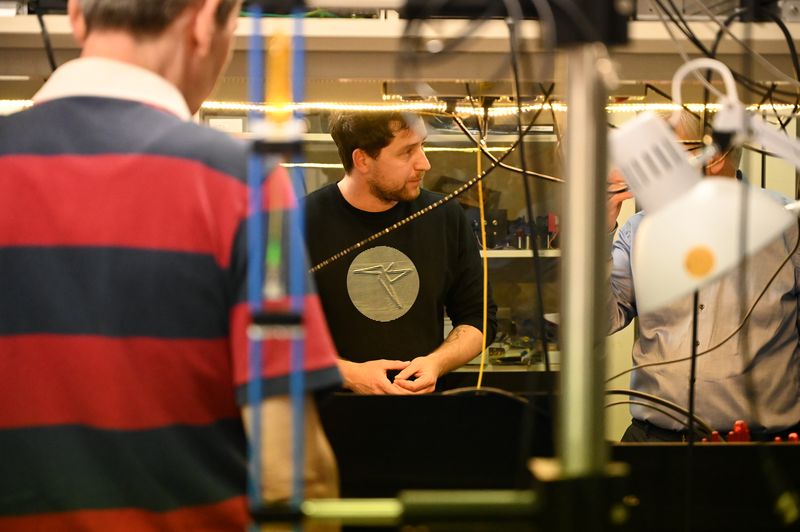
The visitors take a look at the setup for the micro-mirror production.

The CEO uses an animation to demonstrate what Qlibri's resonators look like. One mirror is a “large” planar mirror on which the object to be examined can be placed. The second mirror is concave, only a few micrometers in size – about the size of a red blood cell – and is mounted on the tip of an optical fiber. The small mirror scans the surface of the large mirror, gradually building up the image. Noé emphasizes that having the small mirror of their resonator located directly on the optical fiber is another advantage of Qlibri's technology. “No matter what the application is or what I’m examining – at some point, the light has to enter the fiber.”

During the lab tour, the guests get a vivid demonstration of the technical expertise required to manufacture resonators of this kind. Looking at the extremely thin glass fibers, it’s hard to imagine how it’s possible to apply a mirror surface to the end of the fiber that is even significantly smaller than the fiber’s own diameter. High-precision alignment tools are used to align the laser beam, which “etches“ the curvature for the parabolic mirror, with the end of the glass fiber. A young employee explains the exact procedure in detail and seems delighted by the many questions. The fact that an Xbox controller is used to control the laser and other settings and steps draws laughter. The employee emphasizes that the Xbox controller is actually particularly practical for handling the various controls during mirror production. He adds that the ability to use it for this purpose is “one of the advantages of programming all your software yourself.” On an enlarged live image, visitors can observe how the surface structure of the optical fiber changes when the laser “fires“ at it. In mirror production, many steps are performed manually, the employee explains in response to a guest’s question. This is because very specific customer requests are usually fulfilled, each of which requires a custom resonator design. “Depending on the application, the resonator must have a specific geometry.“ Sometimes, the concave mirror needs to be more strongly curved; other times, less so. Sometimes, larger mirror surfaces are needed; other times, smaller ones. Not all customer requests are realistic. “We are the experts on how the resonators work, what the physical limitations are, and what can therefore be implemented.”

Maintaining a distance stable to within one-tenth of an atom

The next station focuses on the absorption microscopes produced by the start-up, which are a concrete application of Qlibri’s micro-resonators. Here, the guests get a close look at the microscope’s internal structure and can watch a live video of the scanning process – with its rapid mirror movements – and see how the image gradually takes shape. In the final lab, the start-up presents its quantum technology platforms to the guests, that is, micro-resonators that are characterized, among other features, by extreme stability. In his introductory lecture, Jonathan Noé has already pointed out what extreme stability means: the distance between the mirrors can be kept stable to within one-tenth of an atom. The start-up’s resonator modules are therefore suitable for studying quantum systems and, in particular, for use in cryostats, where pumps can cause disruptive vibrations.

After the lab tour, the team members are available to answer further questions over refreshments – an offer that the visitors are happy to accept. The young team also seems delighted by the opportunity to give such an interested audience a glimpse into their work and share their fascination with the technology being developed in Qlibri’s labs.