The MQV Quantum Year got off to a brilliant start in February with Prof. Rainer Blatt's lecture "100 Years of Quantum Physics – and That's Just the Beginning." Around 350 guests flocked to the Bavarian Academy of Sciences (BAdW) to join Blatt on a whirlwind tour through the history of quantum physics. The experimental physicist captivated his audience with his presentation, which covered everything from the initial theoretical considerations at the beginning of the 20th century to current research and development of innovative technologies such as quantum computing. "My lecture is titled ‘And that’s just the beginning,’" said Blatt, "and that’s something I truly believe in."
Looking back on the Year of Quantum 2025
The International Year of Quantum Science and Technology 2025 is coming to an end. Proclaimed by the United Nations on the occasion of the 100th anniversary of the formulation of quantum mechanics in 1925, universities, research institutions, scientific societies, and many more around the world participated in the Quantum Year. Munich Quantum Valley (MQV) also organized numerous activities and events to celebrate the Quantum Year with its community and, in particular, to take the public on a journey into the impressive world of quantum mechanics. A look back at the highlights.
MQV-Einblicke: A rare glimpse behind the scenes and into the laboratories

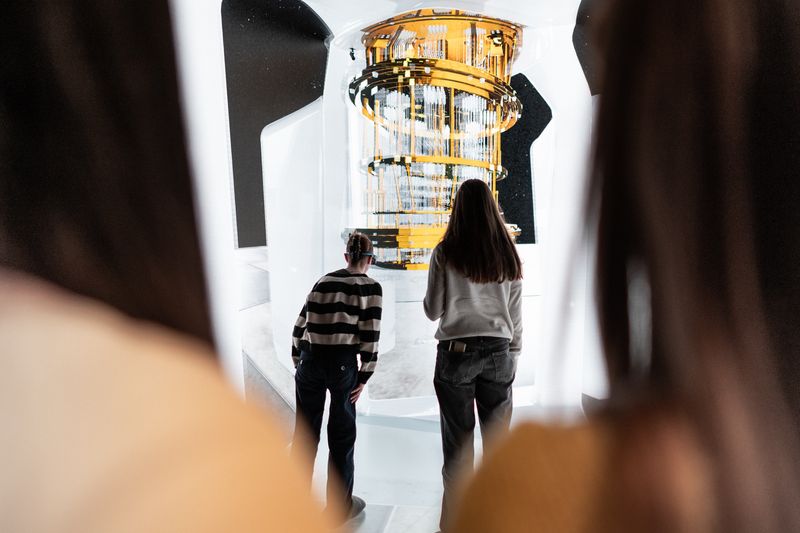
Blatt's lecture was also the first event in the series “MQV-Einblicke – 100 Jahre Quantenwissenschaften und woran wir heute forschen” (MQV Insights - 100 Years of Quantum Science and What We Are Researching Today), in which MQV invited guests to its member institutes throughout the quantum year to experience their current cutting-edge research on site. The evening events, most of which were completely booked out, offered guests the opportunity to learn about various aspects of quantum technology research and take a look behind the scenes and into the laboratories. At the Max Planck Institute of Quantum Optics, visitors had the rare opportunity to visit a quantum optics laboratory and see up close the complex experimental setups used to trap and control individual atoms. At Friedrich-Alexander University Erlangen-Nuremberg, Prof. Florian Marquardt and Prof. Christopher Eichler introduced guests to the world of superconducting quantum computers before they were given a tour of a laboratory where superconducting quantum processors are researched and where they could examine wafers and tiny chips with superconducting structures. Superconducting technologies were also the focus at the Fraunhofer Institute for Microsystems and Solid State Technologies, where Daniela Zahn took the audience on a journey into the tiny, ice-cold world of superconducting quantum computers and her colleagues presented a special innovation from the institute: flexible, foil-based, superconducting cables, which visitors were then able to see being manufactured. Crystals so thin that they can be described as two-dimensional were introduced to guests at the Chair of Experimental Solid State Physics at Ludwig-Maximilians-Universität München, where they could see for themselves how the novel quantum materials being researched at the chair are manufactured.
In the second half of the year, the MQV invited visitors to the new premises of the Max Planck Society's semiconductor laboratory. Its director, Jelena Nincovic, provided an insight into the development of high-precision semiconductor technologies and the work in the clean room, which is kept almost completely particle-free at great expense due to its high purity class and was therefore visited virtually by the guests. Prof. Jonathan Finley explained to visitors to the Walter Schottky Institute how researchers generate individual light particles at the touch of a button. Visitors were then able to experience firsthand how sensitive such experiments can be, as the increased room temperature caused by the presence of the guests prevented the experiment from being carried out—an authentic impression of everyday research. At the Fraunhofer Institute for Cognitive Systems, quantum computing is being researched on another level: here, visitors could learn more about the possible applications of quantum computers, get to know quantum algorithms, and even build small quantum circuits themselves using an application. It was back to hardware development at the event at the Walther Meissner Institute of the BAdW, where quantum systems at the lowest temperatures are being researched and where guests were particularly impressed by the sparkling gold cryostats required for superconducting quantum computing. Visitors were equally impressed by the huge machines and server racks at the Leibniz Supercomputing Centre, where, among other things, the integration of quantum computers into high-performance computing centers is being researched and tested. “You don't usually get to see something like this,” said one participant enthusiastically. At the end of the year, the German Space Operations Center of the German Aerospace Center in Oberpfaffenhofen opened its doors and allowed guests to gaze into the distance. Metaphorically, during a presentation on the potential use of quantum technologies in space travel, and quite literally on the screens in the control rooms, which broadcast live footage of astronauts working in the Columbus module of the International Space Station (ISS).
As diverse as the facilities and topics visited were, one thing always remained the same: the unbroken interest of the visitors and a never-ending stream of questions. The “MQV-Einblicke” series will therefore continue next year – after the initial spark provided by the Quantum Year. The first dates for 2026 have already been set.
From the lab to the pub: Quantum Special at Pint of Science

While the "MQV-Einblicke" series brought the audience into the labs, another event took the scientists out of the lab: Together with Pint of Science, MQV organized a quantum special of the popular science festival and transformed the Haderner Bräustüberl into a quantum pub. On three completely sold-out evenings, scientists from the MQV network took the audience on an exciting and informative journey through various areas of quantum science and technology. Not only the audience, but also the speakers clearly enjoyed bringing quantum technologies and pubs together – beers were "entangled" with each other and remarkable parallels were drawn between beer brewing and the compilation of quantum algorithms.
The perfect souvenir for the event were the specially made MQV beer coasters printed with gate symbols that can be used to build quantum circuits. The coasters have been extremely popular ever since and have been used on many other occasions, such as the Island Festival of the Deutsches Museum and the science fair FORSCHA – both classics in the MQV event calendar, which were given special anniversary attention this year.
Bavarian Quantum Day: Festive program for the anniversary
A special event in the Quantum Year 2025 was the Bavarian Quantum Day in October, which was organized by the Bavarian State Ministry of Science and the Arts (StMWK) with the participation of the MQV under the motto "100 Years of Quantum: From theory to transformation." The morning was devoted to promoting young talent with a school program at the Deutsches Museum. More than 120 students took the opportunity to gain a comprehensive insight into the field of quantum sciences and technologies that went far beyond the topics covered in the curriculum through lectures, guided tours of the "Light and Matter" exhibition, experiments at hands-on stations, and direct exchanges with young scientists.
An afternoon scientific program at the BAdW and a festive state reception at the Residenz provided the quantum community and representatives from industry and politics with a proper setting to celebrate the centenary of the formulation of quantum mechanics. The MQV had double reason to celebrate, announcing the formal founding of MQV GmbH and thus setting its sights firmly on the future. Because 100 years of quantum – that's just the beginning.


